
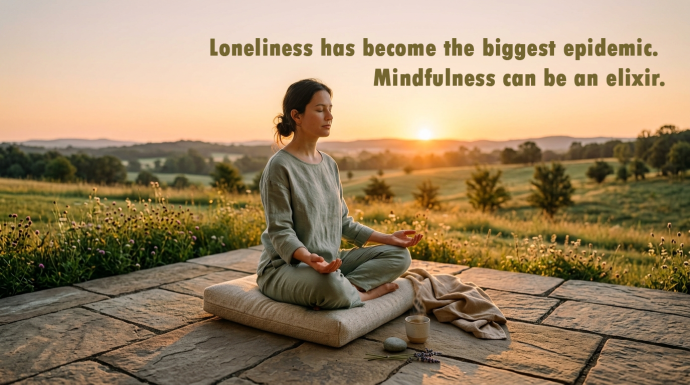
What if you could be even 1 or 2 percent happier? Meditation, even for a few minutes at a time, can be hugely beneficial.
You Are Not Alone in Being Lonely
The extent of mental illness has disproportionately increased post-COVID. The pandemic forced people who were already experiencing stress into isolation, and loneliness is a breeding ground for anxiety.
Loneliness has become the biggest epidemic that the world is facing. We spend more time on the internet scouring the news, which is negative. It makes us feel even more lonely because we fear that nobody cares for us — which is unfounded — and that loneliness just pervades.
Mindfulness, one type of meditation, can be an elixir. It's interesting to understand why it is necessary and why it works.
Pay Attention to What You Pay Attention To
The brain wants to put as much as possible into the unconscious, which helps you to get through life quickly. But that knowledge base is marked by emotions. This accumulation of unacknowledged emotions can be manifested as forms of stress. This is where mindfulness can be helpful as a method of recognizing and slowing that process.
Mindfulness is the deliberate, intentional focus in a nonjudgmental way. By being aware of how crucial your attention is, you can understand that where you put your attention has an impact on who you are and — more importantly — who you're going to be.
This is the first step toward a meditation practice. Without self-awareness you're a cork in the ocean. By paying attention deliberately, and being aware of more positive things, you're creating a future for yourself that's going to be more positive, and one you're more connected with.
Breathe Through It
Learning to calm and control your breathing is a powerful tool. We can use the breath to control our anxiety and our mood.
Try the pranayama breathing technique, or consider joining a yoga practice at a local community centre — readily available and inexpensive — since this also combats loneliness. The admonishments to "keep in shape" and "stay healthy" are associated almost solely with our bodies from the neck down. But the benefits of being mindful, and learning to calm and relax our thoughts, are incontrovertible.
Therapists use the "thought train" analogy: you are a passenger on a train; the passing landscape represents your thoughts. Allowing the thoughts to simply pass by, without judgment, is the essence of mindfulness, and the seed of meditation.
What Self-Care Really Means
Research has consistently shown that mindfulness improves brain volume, increases grey matter, lessens the chances of dementia, and reduces depressive symptoms and anxiety. There are cardiovascular benefits too: reducing the chances of stroke and heart attacks, and supporting immune function.
By Kenny Bodanis
Disclaimer: This article is intended for informational purposes only and does not constitute medical advice. If you are experiencing mental health challenges, please reach out to a qualified healthcare professional or contact a mental health support line in your area.