Fish oil is one of those purchases where the front of the bottle tells you almost nothing useful and the numbers that matter sit further down. Fish oils are globally among the most popular dietary supplements (1). Below is the walk we do at the counter: what the shelf holds, what separates one option from another, and what a first-time buyer usually leaves with versus someone on their fourth bottle.
Key takeaways
- EPA and DHA are the two long-chain omega-3 fats counted on an omega-3 product; the total oil weight is not the same number.
- Softgels are the no-fuss format; liquids let one bottle cover a household and cost less per gram of oil.
- An omega 3-6-9 blend is a different product from a fish oil, built on seed oils rather than marine oil.
- Freshness is real: heat, air and long storage all work against these oils, so buy a size you will get through.
- We stock 14 fish oil and omega products across 5 brands, all 14 in stock; seven are featured here.
What is the benefit of taking fish oil?
Fish oil is a concentrated source of the long-chain omega-3 fats EPA and DHA, which most diets supply only through oily fish.
Most people do not take in adequate omega-3 fatty acids, and poor omega-3 status is widespread (2). Omega-3 deficiency is a growing nutritional concern in many Western countries (3). That is the gap the category exists to close, and it is the honest reason most people start a bottle.
If you eat sardines or salmon several times a week, you are already covering ground a capsule would cover. If you eat fish rarely, the arithmetic changes.
What do EPA and DHA mean on a fish oil label?
EPA and DHA are the two omega-3 fatty acids that fish oil is bought for, and the milligram figures beside them are the numbers to compare between bottles.
The trap is comparing the wrong number. A softgel might be 1,000 mg of fish oil but hold only 300 mg of combined EPA and DHA — the rest is other fats. A concentrated softgel can hold nearly triple that in the same physical capsule.
- Total fish oil per softgel: how big the capsule is.
- EPA + DHA per softgel: what you are actually taking in.
- Combined EPA + DHA per day: the figure worth working out before you compare prices.
Do that division once and two bottles that looked twenty dollars apart often land in the same place.
What separates the bottles on our shelf
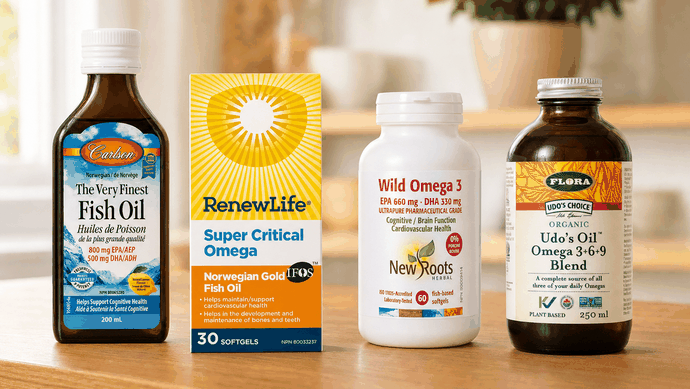
We stock 14 across 5 brands — Carlson, New Roots, Renew Life, Flora and Smart Sweets — and here are seven of them.
| Product | Format | Size | Price | Per unit |
|---|---|---|---|---|
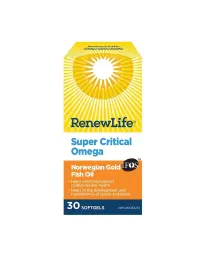
| Renew Life Super Critical Omega Norwegian Gold Fish Oil 30 Softgels | Softgel | 30 softgels | $26.99 | $0.90 each |
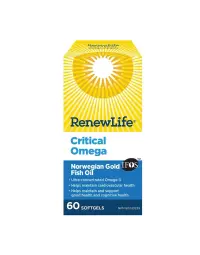
| Renew Life Super Critical Omega Norwegian Gold Fish Oil 60 Softgels | Softgel | 60 softgels | $47.99 | $0.80 each |
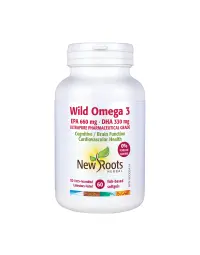
| New Roots Wild Omega-3 EPA 660mg DHA 330mg Fish Softgels | Softgel | 60's | $24.99 | $0.42 each |
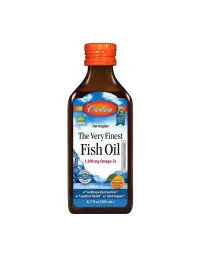
| Carlson Very Finest Orange Fish Oil Liquid | Liquid | 200 mL | $42.56 | — |
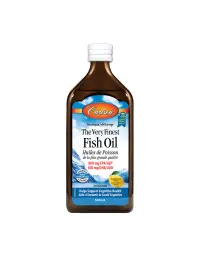
| Carlson Very Finest Lemon Fish Oil Liquid | Liquid | 500 mL | $84.06 | — |
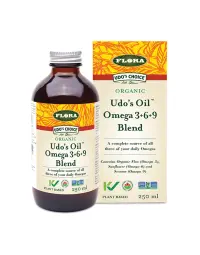
| Organic Udos Oil Omega 3+6+9 Blend | Liquid blend | 250 mL | $17.99 | — |
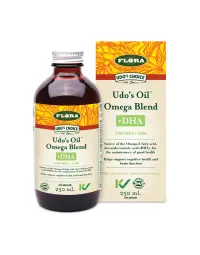
| Udos Oil Omega 3+6+9+DHA Blend Liquid | Liquid blend | 250 mL | $20.79 | — |
First-time buyers almost always take a softgel, and the New Roots Wild Omega-3 at $0.42 a softgel is the usual starting point — it names its EPA and DHA right in the product name, which saves the arithmetic. The Renew Life Norwegian Gold 30-count at $26.99 is the one people buy to try before committing; the 60-count at $47.99 drops to $0.80 a softgel.
Repeat buyers tend to move to liquid. The Carlson lemon 500 mL at $84.06 is more than double the volume of the 200 mL orange at $42.56, and it is the bottle households buy when two or three people are taking it. Browse the rest of the category on our supplements page.
What is the difference between fish oil softgels and liquid fish oil?
A softgel hides the taste and never needs measuring; a liquid gives you far more oil per dollar and lets you adjust the amount by teaspoon.
- Softgels — no taste, no spoon, no fridge negotiation. The format that gets taken on a Tuesday morning without thinking about it.
- Liquid — flavoured (lemon and orange are the two we carry in the Carlson line), much cheaper per gram of oil, and easy to share across a household at different amounts.
- Capsule volume — getting a high combined EPA and DHA amount from softgels can mean swallowing several capsules; a teaspoon of liquid does it in one go.
The practical tiebreaker is not price. A liquid bottle that gets pushed to the back of the fridge is worse value than softgels that get taken, and a person who gags on capsules will never finish a softgel bottle no matter how good the numbers are.
How do you keep fish oil fresh?
Cool, dark and closed — and buy a size you will finish, because these oils do not improve with age.
With longer storage, the safety and quality of omega-3 fish oils may become questionable (3).
In practice: a liquid goes in the fridge once opened, softgels stay out of a sunny window, and a smell that has gone sharp or paint-like is a bottle to stop using. A 500 mL liquid is only a bargain if it is empty before it turns — that is the honest case for buying the 200 mL first.
Is a fish oil the same as an omega 3-6-9 blend?
No. A fish oil is marine oil supplying EPA and DHA; a 3-6-9 blend is built mostly from seed oils and supplies a different set of fats.
The current standards written for fish oil apply to fish oil as its own ingredient (3). That matters when you compare a blend to a straight fish oil — you are not comparing like with like.
Most people already take in plenty of omega-6 from ordinary cooking oils, so a blend is usually chosen for the whole-oil profile rather than to top up EPA and DHA. The Udos blends are the two we carry in that style, and the one with added DHA is the version bought by people who want a plant-forward oil that still names DHA. If you came here for EPA and DHA specifically, buy the fish oil.
Is it good to take fish oil pill everyday? And is it okay to take omega-3 fish oil every day?
Daily use is the ordinary pattern for these products, because omega-3 status builds slowly over weeks rather than shifting after one capsule.
Fish oils are globally popular dietary supplements (1). Omega-3 deficiency is described as a growing nutritional concern in many Western countries (3).
What varies is the amount, not the frequency. Follow the amount stated for the specific product you bought — the concentrated softgels and the liquids are not interchangeable spoon-for-capsule, and a teaspoon of liquid can carry several times what one standard softgel carries.
Who should not take fish oil?
Anyone taking blood-thinning medication, anyone scheduled for surgery, and anyone with a fish or shellfish allergy should sort this out with a person before starting.
That last one is straightforward: a fish-derived oil is not for someone who reacts to fish, and krill oil is shellfish-derived. Pregnancy and childhood amounts are their own conversation and differ from the adult figures printed on most bottles.
For everything in the first sentence, a pharmacist will work through it with you across the counter, and there is one in this building.
Is krill oil or algae oil better than fish oil?
Neither is a clear upgrade — they are different sources of the same omega-3 fats, chosen for different reasons.
The practical reasons people choose differently: algae oil is the marine-free option for vegetarians and vegans, and krill is often chosen by people who find fish oil repeats on them. If neither of those applies to you, fish oil is the well-mapped choice.
What does ethyl ester mean on an omega-3 product?
It describes the chemical form the omega-3 is in after concentration — the oil has been reacted with ethanol to strip out the fats you did not want.
The alternative to the ethyl ester form is a triglyceride form, which is closer to how the fat sits in the fish itself; some concentrates are converted back after the concentration step.
Ethyl ester products get you more EPA and DHA into a single capsule, which is the whole point of a concentrate.
Buying from us
We are an independent store with a range picked by the people who work here, and we ship Canada-wide to every province and territory, with free standard shipping over $85.
In Kitchener-Waterloo there is local pickup and local delivery, and the store itself is open if you would rather smell the liquid before you commit to 500 mL. Greenbrook Pharmacy operates next door as its own business; the shop described here is the natural-foods store.
References
- Jairoun AA, et al.. Fish oil supplements, oxidative status, and compliance behaviour: Regulatory challenges and opportunities. PLoS ONE. 2020. PMC7774961 (retrieved 2026-08-07) https://pmc.ncbi.nlm.nih.gov/articles/PMC7774961/
- Dempsey, et al.. The influence of dietary and supplemental omega-3 fatty acids on the omega-3 index: A scoping review. Frontiers in Nutrition. 2023. DOI 10.3389/fnut.2023.1072653 (retrieved 2026-08-04) https://doi.org/10.3389/fnut.2023.1072653
- Jackowski SA, et al.. Oxidation levels of North American over-the-counter n-3 (omega-3) supplements and the influence of supplement formulation and delivery form on evaluating oxidative safety. Journal of Nutritional Science. 2015. PMC4678768 (retrieved 2026-08-07) https://pmc.ncbi.nlm.nih.gov/articles/PMC4678768/
Retail information only. Greenbrook Natural Foods is a natural-foods store in Kitchener-Waterloo. What a product is, what its own label and licence record state, which brands carry it and what it costs here are the store’s own statements; anything attributed to a published source is that source’s, and is cited above. No advice of any other kind is offered. Read the manufacturer label before use, and take any question about your own care to a qualified practitioner.